

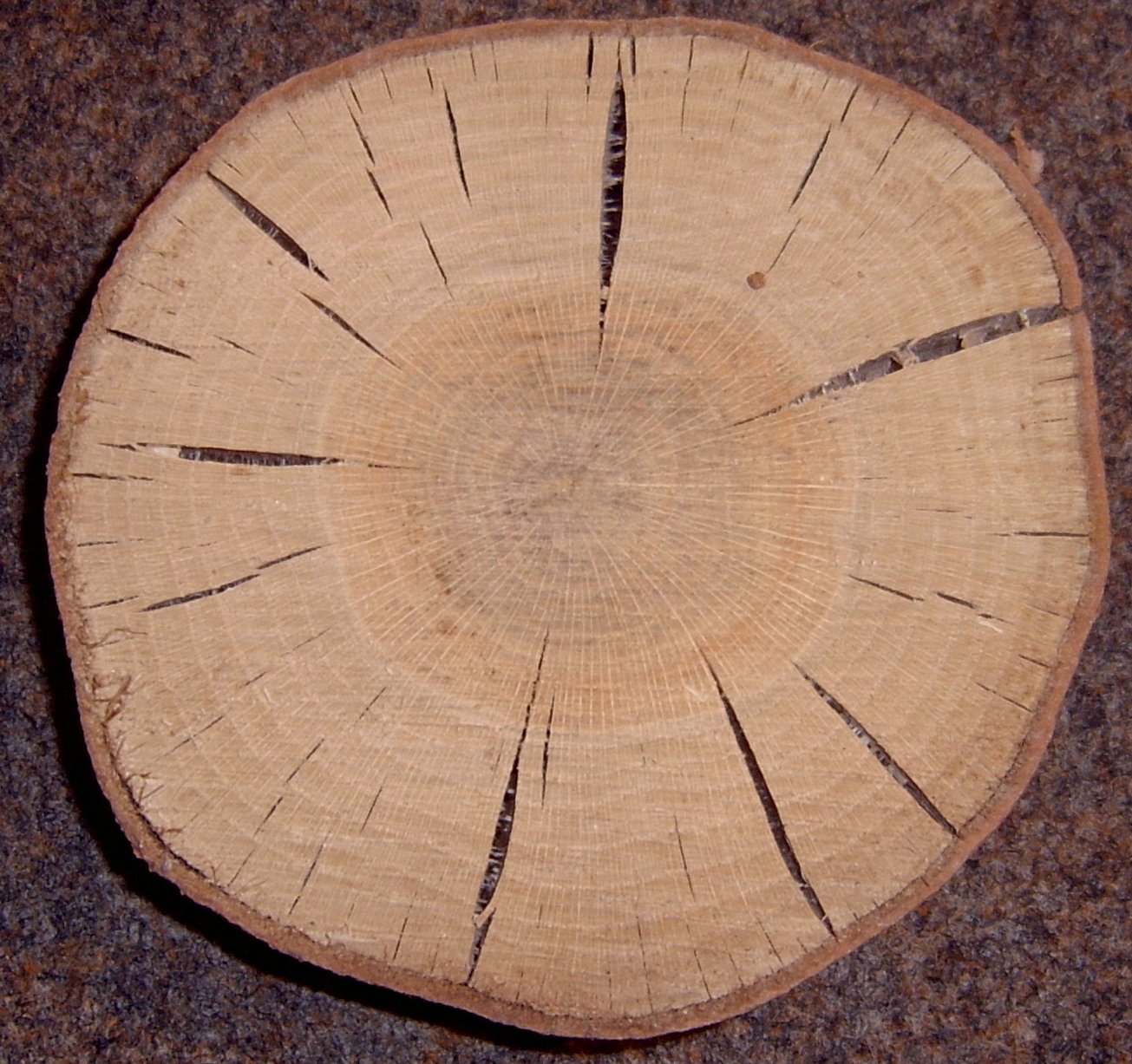
Wikimedia Commons contributor, Public domain, via Wikimedia Commons
Wood Species
Red Oak
Quercus rubra
- Janka hardness
- 1290 lbf
- Specific gravity
- 0.63
- Workability
- Good with both hand and machine tools
Red oak (Quercus rubra) is the wood most North American lumberyards assume you mean when you just say "oak" — a staple of furniture, cabinetry, and flooring, with reddish-brown heartwood and pale sapwood bold enough to spot from across the shop.
Working Properties
At a Janka hardness of about 1,290 lbf, red oak sits comfortably above walnut and cherry, and just as comfortably below white oak and hard maple — the middle-of-the-pack hardwood everyone reaches for first. It saws, planes, and routs cleanly, takes screws and glue well, and generally behaves. The one place it won't cooperate: it's ring-porous with big, open pores, so it never sands as glassy-smooth as a diffuse-porous wood like maple or cherry without a pore filler stepping in first.
Those same open pores are a double-edged sword. Outdoors or anywhere wet, they let decay in — unlike white oak, red oak has no business outside. But indoors, that porosity soaks up stain and finish evenly, which is exactly why it's been the default kitchen-cabinet wood for decades running.
Movement and Stability
Red oak isn't shy about moving with the seasons — tangential shrinkage (green to oven-dry) runs around 8.6%, versus about 4.0% radially, a roughly 2:1 ratio typical for oak. Translated: flatsawn (tangential-cut) boards will visibly expand and contract across their width more than quartersawn boards cut on the radial face. Run your own project's width and local humidity swing through the Wood Movement Estimator before you commit to a panel size.
Safety
Red oak dust is a respiratory irritant like any wood dust, and prolonged unprotected exposure to fine dust of any species carries real long-term health risks recognized by OSHA and NIOSH. Dust collection at the source, a properly rated respirator when sanding or machining — non-negotiable, regardless of species.
Typical Uses
Furniture, cabinetry, flooring, moulding, millwork — the usual suspects. Its strength-to-weight ratio also lands it in tool handles and other spots where a little shock resistance earns its keep.
Recommended Finishing Supplies
Because red oak's open pores show through a finish more than a diffuse-porous wood like maple, a pore filler and a penetrating oil are common companions:
Disclosure: As an Amazon Associate, this site earns a commission from qualifying purchases made through the links below.
(Links above are placeholders pointing to generic Amazon search results — they'll be replaced with real Amazon Associates affiliate links once that account is approved.)
Images
Raw Wood: Foto taken by Lumbar 16:32, 6 November 2005 (UTC) in Osnabrück — Wikimedia Commons contributor, Public domain, via Wikimedia Commons
Images are sourced from Wikimedia Commons under their original open licenses -- see each image's caption for its specific license and attribution.