

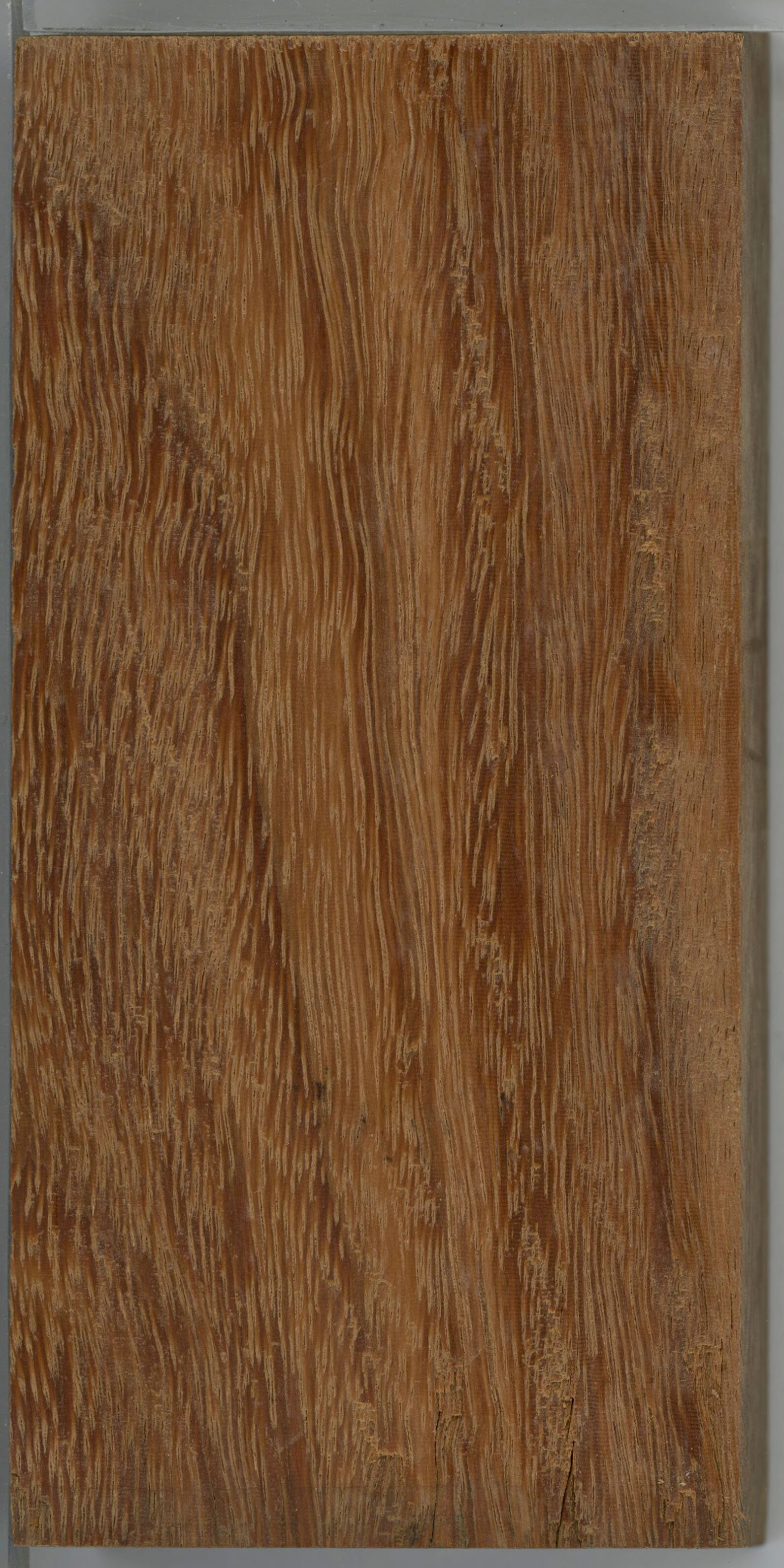
Wikimedia Commons contributor, Public domain, via Wikimedia Commons
Wood Species
Brazilian Teak (Cumaru)
Dipteryx odorata
- Janka hardness
- 3540 lbf
- Specific gravity
- 0.95
- Workability
- Difficult — dense, interlocked grain, silica content blunts cutters; oily and hard to glue
Despite the name, Brazilian Teak has no botanical relation to true teak (Tectona grandis) — it's the flooring-trade name for cumaru (Dipteryx odorata), a considerably harder, denser South American hardwood that just happens to land in a similar golden-brown color range.
Working Properties
Cumaru gives off a faint vanilla-or-cinnamon smell while you're working it, a genuinely useful tell if you're trying to confirm what's actually on your bench. Beyond the pleasant smell, it's a fight: dense, interlocked grain, and enough silica content to noticeably dull cutters. High oil content and density also gang up against gluing — pre-boring is mandatory before any screw or nail goes in. The payoff is a wood rated very durable against decay and resistant to termites and other dry-wood borers.
Typical Uses
Decking and flooring (its dominant uses), plus cabinetry, furniture, heavy construction, and railroad ties.
Images
Raw Wood: Sujet : Bois - Régions tropicales Numérisation effectuée à partir d'un document original : CD_Techno-Xylothèque-CTFT-1490. Appartient à l... — Wikimedia Commons contributor, Public domain, via Wikimedia Commons
Images are sourced from Wikimedia Commons under their original open licenses -- see each image's caption for its specific license and attribution.